
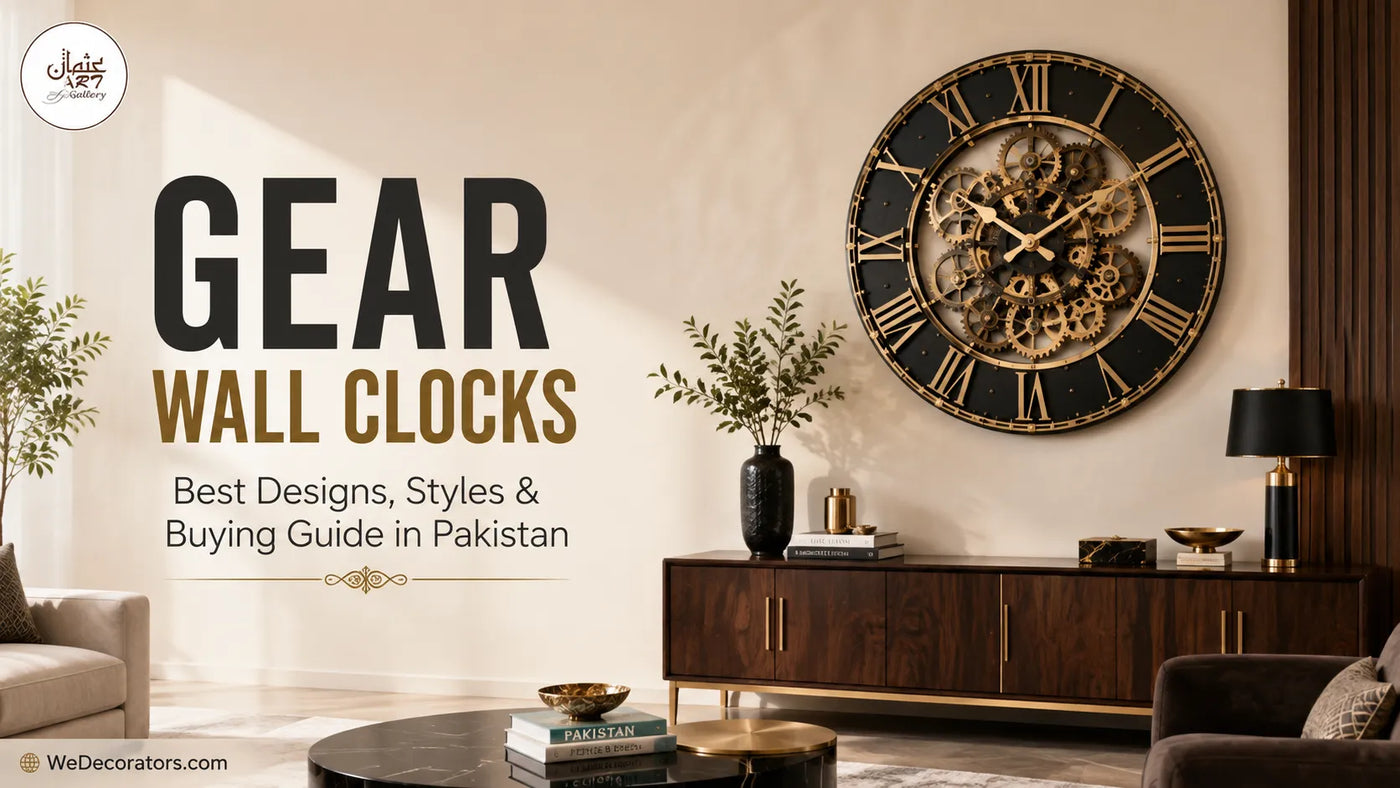
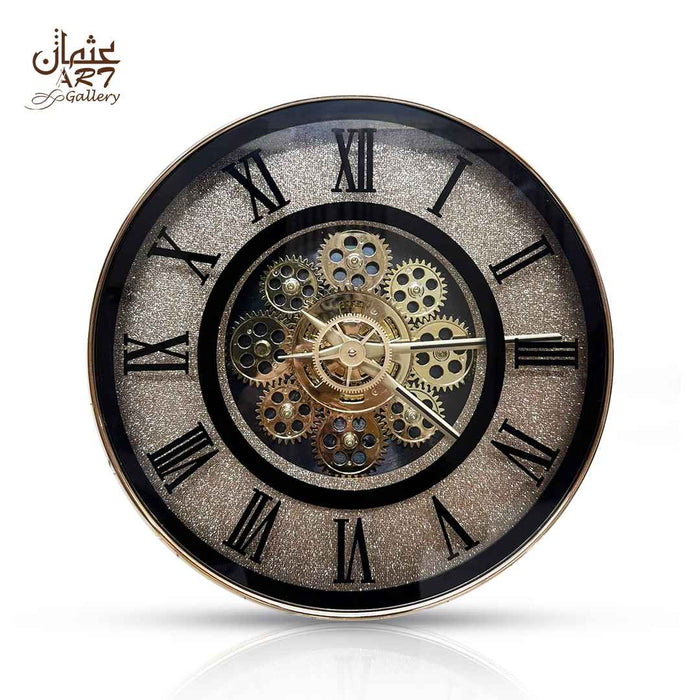
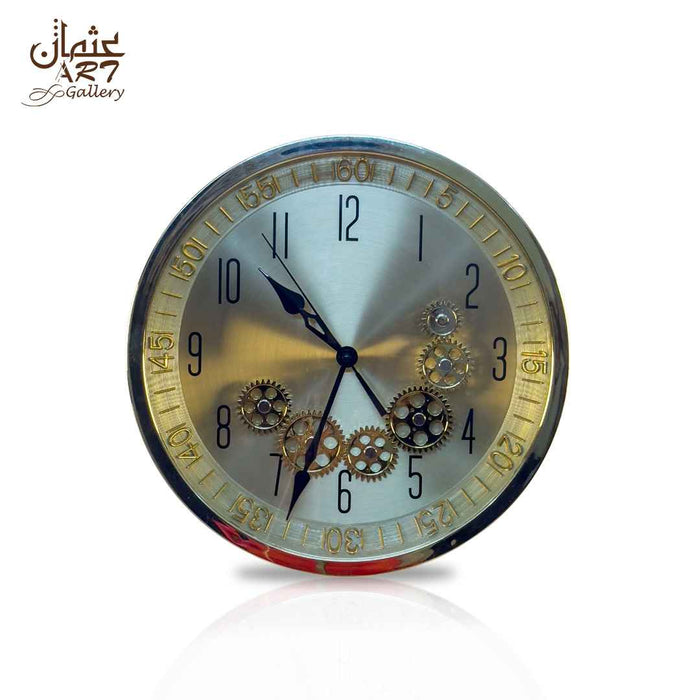
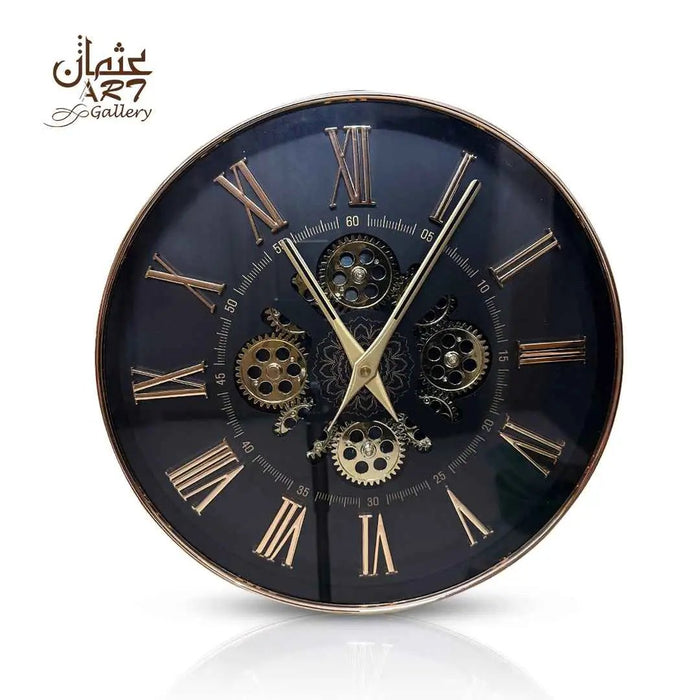
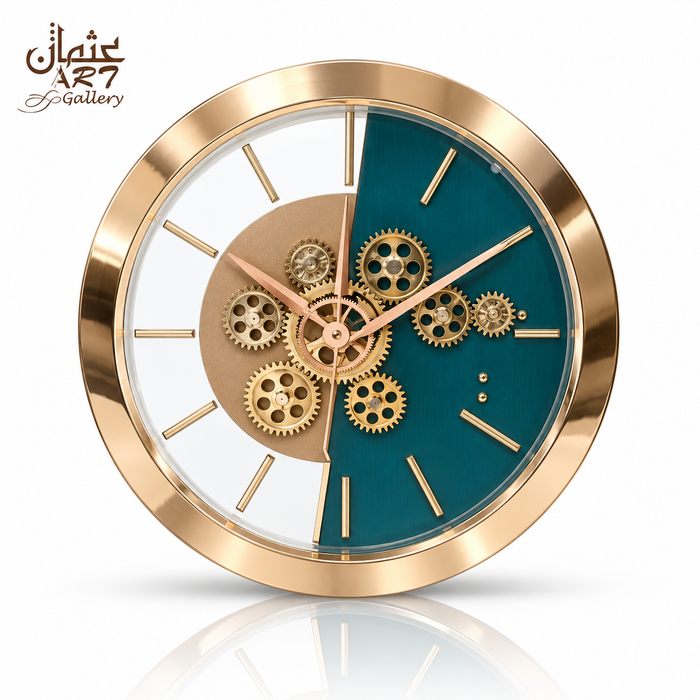

Gear wall clocks are designed for people who want a wall clock to do more than simply display the time. Their exposed cog-style details, layered centres, metallic finishes, Roman or Arabic numerals and mechanical-inspired appearance can turn an ordinary wall into a stronger visual feature. They are particularly popular for living rooms, drawing rooms, offices, studies, reception areas and feature walls where a plain clock may feel too simple.
However, one important detail causes considerable confusion when shopping for a gear wall clock in Pakistan. Visible gears do not automatically mean that those gears move, and moving decorative gears do not automatically mean that the clock uses a mechanical timekeeping movement. Some designs have rotating decorative gears. Others use stationary gear detailing. Many decorative models can still use quartz timekeeping.
This detailed guide explains those differences before helping you compare gold, silver, black-and-gold, Roman numeral, vintage, industrial and moving-gear styles. You will also learn how to choose the correct clock size, match the finish with your wall colour, position a gear clock in different rooms and compare currently available WeDecorators designs without making assumptions about unverified specifications.
Key Takeaways About Gear Wall Clocks
- Gear wall clocks are a design category, not one single type of clock mechanism. Exposed gears can be moving, stationary or purely decorative.
- A moving gear wall clock is not necessarily a mechanical clock. Decorative gears may rotate separately while a quartz mechanism controls the clock hands.
- Never judge gear movement from photographs alone. Check whether the seller explicitly states that the gears rotate.
- Size should be judged by both diameter and visual weight. Dense gear detailing, dark colours, thick frames and bold numerals can make a clock appear larger than a simpler design of the same diameter.
- Gold and black-and-gold gear clocks create warm, high-contrast focal points. Silver usually integrates more naturally with cool grey, white, black and contemporary colour schemes.
- Roman numeral gear clocks combine classic and industrial styling. Arabic numeral models usually create a slightly more contemporary everyday appearance.
- Placement matters. A detailed clock usually benefits from more negative space than a minimalist clock.
- Pakistani shoppers should verify live PKR pricing, dimensions, movement, gear operation, delivery coverage, mounting and return terms before ordering.
What Is a Gear Wall Clock?
A gear wall clock is an analogue wall clock that incorporates visible gears, cogs or mechanical-inspired components into its design. The gear elements may be stationary or rotating depending on the individual model. The actual timekeeping movement may also be separate from the decorative gears, which means a gear-style clock can still use quartz timekeeping.
The main difference between a conventional wall clock and a decorative gear wall clock is visual complexity. A basic clock may contain little more than a dial, hour markers and hands. Gear clocks introduce additional layers such as cog shapes, metallic circles, open sections, skeleton-style centres, visible decorative mechanisms or contrasting finishes.
These elements create depth. Instead of looking like a flat object attached to the wall, the clock can have a stronger three-dimensional appearance, particularly where darker gears sit behind metallic numerals or where an open dial reveals multiple layers.
For this reason, gear wall clocks are often selected as statement wall clocks. They provide practical time display while also performing the decorative role normally filled by wall art, mirrors or other feature pieces.
Some designs are clearly industrial, with dark frames, exposed metal-style detailing and vintage finishes. Others use gold, polished metallic colours and cleaner forms to create a more contemporary or luxury-inspired appearance.
If your primary interest is in broader ornamental clock styles rather than gears specifically, see our guide to decorative wall clock styles. For clocks used primarily as functional artwork, you can also explore how artistic wall clocks work as wall art.
How Do Gear Wall Clocks Work?
The answer depends on the clock. The hands need a timekeeping movement, while any decorative gears may operate separately. A clock can therefore have one mechanism controlling the time and another component controlling visible gear movement.
This distinction is essential because phrases such as mechanical gear wall clock, moving gear clock, exposed gear clock and decorative gear clock are sometimes used loosely in product names.
The safest approach is to separate the clock into two questions:
- How does the clock keep time?
- Do the visible decorative gears physically rotate?
Those questions should be answered independently.
Do the Gears on Gear Wall Clocks Actually Move?
Some gear wall clocks have gears that physically rotate, while others use stationary gears purely for decoration. Visible cogs are therefore not proof of movement. Buyers specifically searching for a moving gear wall clock should look for an explicit specification confirming rotating or moving decorative gears.
There are four common arrangements worth understanding.
1. Moving Decorative Gears
A genuine moving gear wall clock contains visible cogs or gear elements that rotate while the clock is operating. Their primary purpose is usually visual rather than timekeeping.
The constant movement creates additional visual interest, particularly when multiple gears rotate at different positions inside a skeleton-style or open-face design.
However, moving decorative gears can create additional considerations. They may require separate batteries, introduce another motor and potentially create additional operating sound. None of those details should be assumed. Check the exact specification.
2. Stationary Decorative Gears
A decorative gear clock may contain layered cogs that never move. These components provide the appearance of mechanical complexity while functioning purely as decorative elements.
For many interiors, stationary gears can be entirely suitable. Someone may want the industrial or mechanical aesthetic without caring about continuous movement.
Stationary decorative gears can also provide a visually detailed centre without introducing an additional gear motor.
3. Quartz Timekeeping with Moving Decorative Gears
This combination is particularly important to understand. A clock may use a conventional quartz movement to control the hour, minute and second hands while separate decorative gears rotate inside the face.
In other words, moving gears do not automatically make the clock mechanically powered.
4. Genuine Mechanical Timekeeping
A genuine mechanical clock keeps time through stored mechanical energy. Depending on the design, that energy may come from a wound spring, weights or another mechanical system.
This is different from a quartz clock that simply looks mechanical.
| Clock Type | Do Decorative Gears Move? | Timekeeping System | Main Appeal | What to Verify |
|---|---|---|---|---|
| Moving decorative gear clock | Yes, when explicitly specified | May be quartz or another stated movement | Visible movement and decorative depth | Gear motor, batteries, sound and timekeeping movement |
| Stationary decorative gear clock | No | Depends on model | Mechanical-inspired appearance | Clock movement and power source |
| Quartz gear-style clock | May or may not | Quartz | Practical timekeeping with detailed styling | Whether the gears operate separately |
| Mechanical clock | Depends on design | Mechanical | Traditional mechanical timekeeping | Explicit confirmation of mechanical movement |
The Four-Part Gear Clock Check Before You Buy
Before buying any gear wall clock online, use this four-part check. It separates visual appearance from the specifications that actually matter.
1. Check Gear Operation
Ask one simple question: Do the visible gears physically rotate?
Look for clear wording such as rotating gears, moving decorative gears or working gear display. If the listing only says exposed gears, mechanical-style, gear-inspired or decorative gear details, rotation should not be assumed.
2. Check the Timekeeping Movement
Identify what controls the clock hands. Common product descriptions may mention quartz, sweep quartz, mechanical movement or another system.
A mechanical-looking clock face does not automatically identify the mechanism behind the hands.
3. Check the Power Requirements
If the gears move, determine whether they use the same power source as the clock movement or require separate batteries.
This matters when comparing two similar-looking products. A clock requiring several batteries for decorative movement may have different running requirements from a stationary decorative gear clock.
4. Check Sound
Look for specific statements about ticking, silent movement, sweep movement or gear-motor noise.
A seller describing the clock movement as silent does not necessarily confirm that separately rotating decorative gears are completely silent. If sound matters in a bedroom, study or quiet office, verify both functions.
Why Gear Wall Clocks Are Popular for Luxury and Statement Décor
The appeal of gear wall clocks comes from their combination of practical function and visual complexity. Their mechanical-inspired centres introduce detail, while metallic finishes and structured numerals can create a clear focal point.
Several design characteristics contribute to that effect.
Layered Visual Depth
Conventional flat dials depend mainly on colour and typography. Gear clocks can introduce overlapping circles, cogs, frames and open areas. These layers allow light and shadow to interact with the face differently throughout the day.
Strong Geometry
Repeated circular gears work naturally with the round shape of a conventional analogue clock. Roman numerals, outer rings and radial hour markers reinforce that structure.
Metallic Contrast
Gold, bronze, steel-grey and silver finishes create highlights that can stand apart from matte walls, wooden furniture or neutral upholstery.
Industrial Character
Exposed gear styling has a natural relationship with industrial interiors, black metal furniture, leather, wood and darker colour palettes.
Classic and Contemporary Combination
A Roman numeral gear clock can combine a traditional outer dial with a modern mechanical-style centre. That makes the design useful for transitional interiors that mix contemporary furniture with classic details.
However, a luxury gear clock is not created by gold colour alone. Scale, proportion, finish, readability, wall placement and surrounding décor all influence whether the clock appears considered or excessive.
Main Types of Gear Wall Clocks
Gear wall clocks are available in several visual directions. Understanding these categories can make product comparison much easier.
Gold Gear Wall Clocks
A gold gear wall clock creates a warm metallic focal point and works particularly well in interiors containing beige, ivory, cream, brown, black, walnut or deep green.
Gold can also connect with brass-effect handles, pendant lights, mirror frames or decorative accessories. The goal is usually repetition rather than exact matching.
A gold clock becomes more noticeable on a charcoal or deep green wall because of the stronger contrast. Against ivory or cream, the same clock can create a softer and warmer result.
Black and Gold Gear Wall Clocks
Black and gold is one of the strongest combinations for mechanical-inspired décor. Black provides structure and definition, while gold highlights important elements such as numerals, gear details or hands.
A black and gold gear clock can work particularly well in drawing rooms, offices and living rooms containing dark furniture, black metal, walnut finishes or warm neutral upholstery.
It is also easier to use black-and-gold against a pale wall because the darker outer sections create immediate separation from the background.
Silver Gear Wall Clocks
Silver offers a cooler alternative to gold and bronze. It can coordinate with white, grey, charcoal, black, chrome, glass and mirrored furniture.
A silver gear wall clock can be particularly effective in modern offices or contemporary living rooms where warm metallic tones would feel disconnected from the existing palette.
Be careful when using silver against a light grey wall. If the clock frame, hands and wall all sit within a similar tonal range, readability and visual definition may decrease.
Vintage Gear Wall Clocks
A vintage gear wall clock usually combines aged metallic colours, Roman numerals, distressed finishes, open dials or skeleton-style detailing.
Bronze, steel-grey, antique black and muted gold are common visual directions.
These clocks naturally suit vintage, industrial, rustic and heritage-inspired interiors, but they can also introduce warmth into modern rooms dominated by clean furniture and neutral walls.
For more detailed help with these finishes, read our guide to choosing a vintage wall clock colour in Pakistan.
Roman Numeral Gear Wall Clocks
Roman numerals create an instantly recognisable traditional clock identity. Pairing those numerals with exposed gear-style detailing produces a classic-meets-industrial appearance.
A Roman numeral gear wall clock can therefore work in traditional drawing rooms, modern offices, vintage living rooms and transitional spaces.
When buying, examine the contrast between numerals, hands and background. A highly detailed centre should not make the actual time difficult to read.
Arabic Numeral Gear Wall Clocks
Arabic numerals tend to create a more straightforward everyday display. They can be useful when readability is more important than a strongly traditional appearance.
The simpler numeral system can also balance a detailed centre by keeping the outer time display familiar.
Skeleton Gear Wall Clocks
A skeleton wall clock uses an open design with less visual mass across the dial. The wall behind the clock may remain partly visible through the structure.
This can make a large clock feel visually lighter while still retaining significant detail.
Industrial Gear Wall Clocks
Industrial gear clocks usually emphasise exposed cogs, black or dark metal-style finishes, Roman numerals, bronze tones and visible structural elements.
They work well with raw wood, concrete-style walls, dark shelving, leather seating and black metal furniture.
Moving Gear Wall Clocks
Moving designs introduce genuine visible motion. This can make them more engaging on feature walls, in reception spaces or in rooms where the clock is intended to be observed rather than simply glanced at.
If moving gears are the main reason for your purchase, verify the feature before ordering. Do not treat every gear-inspired design as a moving gear clock.
Gear Wall Clock Style Comparison
| Style | Visual Character | Wall Colours to Consider | Interior Direction | Typical Use |
|---|---|---|---|---|
| Gold gear clock | Warm, metallic and decorative | Ivory, beige, cream, charcoal, green | Contemporary, transitional, luxury-inspired | Drawing room or living-room focal point |
| Black and gold | High contrast and structured | White, cream, beige, grey | Modern, industrial, transitional | Feature walls and offices |
| Silver | Cool and contemporary | White, grey, black, charcoal, blue-grey | Modern and monochrome | Living rooms, studies and workplaces |
| Vintage bronze | Warm, aged and textured | Cream, taupe, green, wood panelling | Vintage, rustic and industrial | Entrances, drawing rooms and feature walls |
| Roman numeral | Classic and architectural | Neutral or contrasting walls | Traditional and transitional | Living rooms, studies and offices |
| Moving gear | Dynamic and highly detailed | Depends on finish | Statement-led, industrial and contemporary | Feature walls and reception areas |
If you are still comparing styles beyond the gear category, explore WeDecorators' modern and artistic wall clock collection.
How to Choose the Right Gear Wall Clock Size
Choosing the correct size is one of the most important decisions when buying gear wall clocks. A clock can look impressive in a tightly cropped product photograph but surprisingly small on a wide living-room wall.
Start with the listed edge-to-edge diameter rather than judging scale from lifestyle photography.
Measure the Actual Wall Area
Measure the usable wall rather than the entire room. Windows, doors, curtains, shelves, television units and furniture can substantially reduce the area available for the clock.
Compare the Clock with the Furniture Below It
A clock installed above a sofa, console or sideboard becomes part of one visual composition. Compare its width with the furniture underneath rather than considering it independently.
A compact gear clock may work well over a narrow console but can feel isolated above a very wide sofa.
Create a Paper Template
Use removable tape, paper or cardboard to mark the listed diameter on your wall before purchasing.
Then view it from the normal seating or standing position. This simple test provides a more realistic understanding of scale than zoomed product photography.
Consider Viewing Distance
A highly detailed clock may look excellent at close range but lose some of its decorative definition when viewed from across a large room.
Likewise, small numerals may be difficult to read from a distant sofa or reception desk.
Consider Visual Weight
Two 13-inch clocks can appear noticeably different in size if one has thick framing, bold Roman numerals, dark colours and dense gear details while the other uses a simple white face.
For very large walls, see our dedicated guide to choosing a wall clock for a large wall and our guide to large wall clocks and statement sizes.
13-Inch vs 22-Inch Gear Wall Clock: Which Size Should You Choose?
A 13-inch gear wall clock and a 22-inch gear wall clock can serve very different decorating needs.
| Size | Usually Better For | Main Advantage | Consider Before Buying |
|---|---|---|---|
| Around 13 inches | Compact walls, bedrooms, studies, hallways, small consoles | Decorative detail without occupying excessive wall space | May feel too small as the only feature on a very wide wall |
| Around 22 inches | Living rooms, drawing rooms, offices and larger feature walls | Greater physical presence and longer-distance visibility | Needs sufficient negative space and suitable mounting |
These are not absolute rules. A detailed 13-inch black-and-gold clock may have stronger visual weight than a larger minimalist design.
Physical Size vs Visual Weight
Physical size describes measurable dimensions. Visual weight describes how strongly an object appears to occupy a wall.
This concept is particularly useful when comparing gear wall clocks because their faces can contain substantially more detail than conventional clocks.
| Design Feature | Typical Effect on Visual Weight |
|---|---|
| Dense exposed gear detailing | Usually increases perceived complexity and presence |
| Black outer frame | Creates stronger definition against pale walls |
| Gold-on-black contrast | Draws attention to the clock |
| Large Roman numerals | Adds visual structure around the perimeter |
| Open skeleton face | Can reduce solid mass while retaining detail |
| Thick outer frame | Usually makes the object appear heavier |
| Minimal dial | Often appears calmer at the same physical diameter |
Visual weight is an interior-design judgement rather than a scientific measurement. Wall colour, lighting and surrounding furniture can all change how large or dominant a clock appears.
Best Wall Colours for Gear Wall Clocks
The best wall colour depends on the clock finish and the amount of contrast required. The goal is to make the frame, hands and numerals visible while integrating the metallic colour with the room.
Gear Clock on a White or Ivory Wall
White and ivory are among the easiest backgrounds for gear clocks.
Black creates strong definition. Gold introduces warmth. Bronze creates an antique contrast, while silver provides a cleaner contemporary appearance.
Gear Clock on a Beige or Cream Wall
Beige and cream naturally support warm metallic colours. Gold, black-and-gold and bronze can all work well.
Introduce darker furniture or accessories if the overall room begins to feel too similar in tone.
Gear Clock on a Grey Wall
Grey works with black, silver and gold. Light grey can provide a contemporary background for black-and-gold clocks, while darker greys can make gold or silver details stand out.
Check contrast carefully when pairing a silver or steel-grey clock with a similar wall.
Gear Clock on a Charcoal or Black Wall
Gold and silver can produce a dramatic contrast against dark walls.
If the clock itself also contains extensive black elements, check whether the outer frame remains visible.
Gear Clock on a Deep Green Wall
Gold and bronze can pair particularly well with deep green. Add warm wood or black furniture to reinforce the contrast without overcrowding the palette.
Gear Clock on Wood Panelling
Wood already contains considerable natural texture. Choose a clock finish that remains distinguishable from the timber.
A black or contrasting metallic frame can provide stronger separation than a brown or bronze finish close to the wood tone.
Gear Clock on Textured Walls
Stone, brick, fluted panels, wallpaper and decorative plaster can compete visually with a detailed clock.
If the background is already busy, consider simplifying the surrounding wall rather than adding several other decorative items.
| Wall Colour | Gear Clock Finish to Consider | Visual Effect | Practical Styling Tip |
|---|---|---|---|
| White / ivory | Black, gold, silver, bronze | Flexible contrast | Use furniture colour to guide the metallic finish |
| Beige / cream | Gold, bronze, black-and-gold | Warm and coordinated | Add darker accents for definition |
| Light grey | Black, gold, contrasting silver | Contemporary | Avoid low contrast between silver clock and grey wall |
| Charcoal | Gold or silver | High impact | Check hand and numeral visibility |
| Deep green | Gold or bronze | Rich warm contrast | Combine with wood selectively |
| Wood panelling | Black or contrasting metallic | Defined decorative focus | Avoid finishes that disappear into the wood |
Where Should You Hang a Gear Wall Clock?
The best position provides both visual balance and practical readability. Because decorative gear clocks contain more detail than basic clocks, they usually benefit from clear space around them.
Gear Wall Clock Above a Sofa
A gear wall clock for a living room can work particularly well above a sofa, but centre it according to the furniture arrangement rather than automatically using the centre of the entire wall.
Leave enough open wall around the clock so it does not compete with cushions, tall plants, lamps or nearby artwork.
Gear Wall Clock Above a Console Table
A console provides a natural anchor. The clock becomes the vertical focal point, while the console creates a stable horizontal base beneath it.
Keep tall lamps and decorative objects away from the centre of the dial.
Gear Wall Clock on a Feature Wall
If the clock itself is the feature, let it perform that role. A complex exposed-gear design rarely needs several equally detailed artworks directly beside it.
Gear Wall Clock in a Drawing Room
Pakistani drawing rooms often contain formal sofas, consoles, mirrors, wood furniture and metallic accents. A gold, bronze or Roman numeral gear clock can complement this arrangement when the finish connects with one or two existing details.
Avoid selecting a very small clock for a broad formal wall unless it is intentionally part of a larger gallery arrangement.
Gear Wall Clock in a Dining Room
Choose a position visible from the main seating area. Metallic details can connect with pendant lighting, cabinet handles or dining-table accents.
Gear Wall Clock for an Office or Study
Mechanical-inspired clocks naturally suit workspaces containing dark shelving, wooden desks, leather furniture or black metal.
For practical office use, readability should remain as important as styling.
Gear Wall Clock for a Reception Area
A detailed clock can contribute to the presentation of a reception wall while remaining functional for visitors and staff.
Check normal viewing distance and glare from ceiling lights.
Gear Wall Clock in a Hallway
Hallways have limited width, so consider clock depth as well as diameter. A compact decorative gear clock can provide character without making the passage feel crowded.
For more room-specific guidance, see how to choose a wall clock for your living room.
How to Style a Luxury Gear Clock Without Making the Wall Too Busy
A detailed luxury gear clock usually looks strongest when it is allowed to provide most of the visual complexity on the wall.
Use Negative Space
Leave clear wall around the clock. This helps the outline remain visible and gives the individual gear details space to be noticed.
Repeat Metallic Finishes Selectively
If the clock is gold, repeat that colour once or twice through a lamp, mirror edge, cabinet handle or small decorative object.
A room does not need every metallic item to match exactly.
Use Furniture as an Anchor
A sofa, console, sideboard or desk can visually connect the clock to the room and prevent it from appearing randomly placed.
Control Competing Wall Art
If a gear clock has a complex face, avoid surrounding it with several small detailed frames unless you are intentionally building a gallery wall.
Consider Lighting
Metallic finishes respond strongly to both natural and artificial light. Position the clock where highlights improve the design without creating excessive glare over the numerals or hands.
Useful combinations include:
- Gold clock + beige wall + walnut console + one gold-tone lamp.
- Black-and-gold clock + ivory wall + black sideboard + warm lighting.
- Silver gear clock + grey wall + black console + chrome accessory.
- Vintage bronze clock + cream wall + dark wood sideboard.
- Roman numeral clock + off-white wall + leather seating + wood furniture.
These examples are starting points rather than fixed interior-design rules. For a broader comparison, see our guide to choosing a luxury wall clock and the premium wall clock buying guide.
Best Gear Wall Clocks from WeDecorators to Compare
The best gear wall clock depends on the wall, room, preferred numerals, colour and required size. For that reason, the following WeDecorators designs are organised by use case rather than presented as an unsupported first-to-fourth ranking.
Product details can change. Check the live product page before ordering, particularly where movement, gear rotation, battery type, material or mounting information has not been confirmed.
Premium Gear Clock: Best Suited to Roman Numeral and Black-and-Gold Styling
The Premium Gear Clock is currently listed at 13 inches edge to edge and is offered in Black and Gold Wing, Black and Gold Non Wing and bundle options.
Its main visual identity comes from prominent Roman numerals and gold-tone mechanical-inspired detailing. This combination makes it relevant to shoppers searching for a Roman numeral gear clock or black-and-gold decorative wall clock.
A 13-inch format can work on smaller and medium wall areas, including above a console, study desk or compact seating arrangement.
The live product page uses “Mechanical Gear Wall Clock” in its description, but the actual timekeeping movement and physical gear rotation are not separately confirmed. Therefore, the design should not be described as having genuine mechanical timekeeping or moving gears unless those specifications are verified.
Luxury Gear Clock: Best Suited to Gold or Silver Interior Palettes
The Luxury Gear Clock is listed as approximately 13 inches edge to edge and is available in Gold and Silver.
This makes the product useful for shoppers deciding between warm and cool metallic finishes while keeping the physical size consistent.
The Gold option can coordinate naturally with beige, cream, dark wood, black furniture and warm metallic accessories. The Silver version may suit grey, white, black, blue-grey, chrome or monochrome rooms.
The listing identifies the design as a decorative gear wall clock with a mechanical-inspired face and battery-powered operation. However, its exact movement type and gear operation are not currently confirmed. It should therefore be described as gear-inspired rather than automatically promoted as a moving gear wall clock.
Fancy Gear Clock: Best Suited to Arabic Numerals and Bold Colour Contrast
The Fancy Gear Clock is another 13-inch design, but its visual language differs from the Roman-numeral products.
It uses Arabic numerals around the outer dial and a layered metallic-style decorative gear centre.
Current options include Black and Gold and Black and Red. Black and Gold creates a warmer metallic look. Black and Red offers a stronger and more expressive colour contrast.
This design may particularly suit buyers who like the idea of a gear clock but prefer conventional Arabic numerals for everyday readability.
The current product information explicitly does not confirm whether its decorative gears rotate. Gear movement should therefore not be claimed unless separately verified.
Vintage Gear Wall Clock: Best Suited to Larger Vintage and Industrial Feature Walls
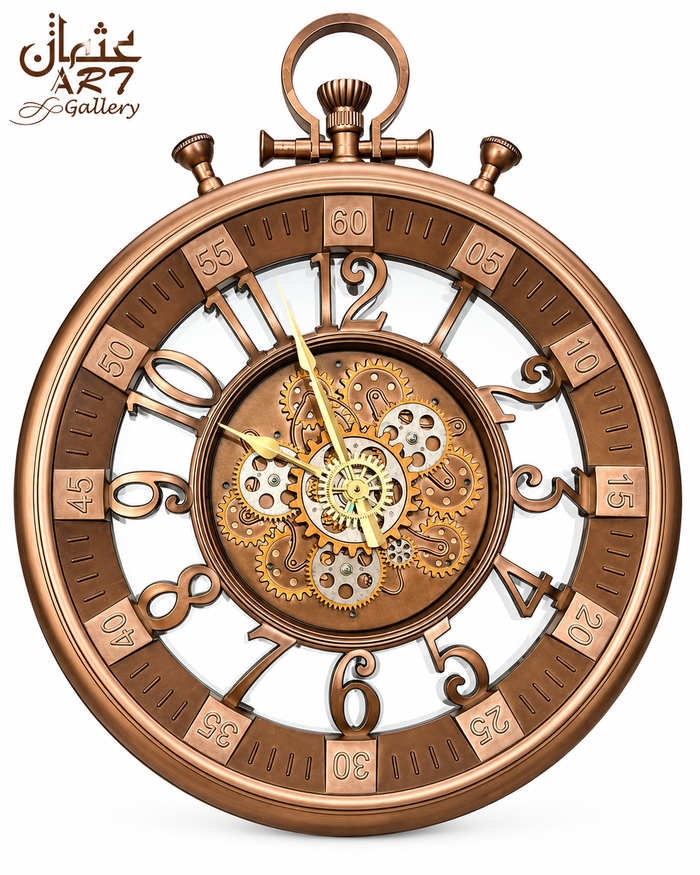
The Vintage Gear Wall Clock differs substantially in physical scale. It is currently listed at approximately 22 inches in diameter.
The design uses a steel-grey and antique-influenced visual direction, Roman numeral framing, a skeleton-style dial and central exposed gear detailing.
The larger diameter makes it particularly relevant to buyers who need greater presence on a living-room, drawing-room, office or entrance feature wall.
Its combination of Roman numerals, open structure and vintage mechanical-style centre can work naturally with wood, black metal, leather, cream walls and industrial interiors.
The visible gears should be treated as decorative detailing unless rotation is explicitly confirmed.
WeDecorators Gear Wall Clock Comparison
| Product | Verified Size | Colour / Finish | Numeral Style | Gear Treatment | Best Styling Direction |
|---|---|---|---|---|---|
| Premium Gear Clock | 13 inches edge to edge | Black and Gold | Roman numerals | Gear-inspired, rotation unconfirmed | Classic, transitional, black-and-gold interiors |
| Luxury Gear Clock | Approx. 13 inches | Gold or Silver | Analogue display | Decorative, operation unconfirmed | Warm or cool metallic interiors |
| Fancy Gear Clock | 13 inches edge to edge | Black and Gold / Black and Red | Arabic numerals | Decorative, operation unconfirmed | Contemporary high-contrast interiors |
| Vintage Gear Wall Clock | 22 inches | Steel-grey / antique-inspired | Roman numerals | Exposed decorative detailing, rotation unconfirmed | Vintage and industrial feature walls |
Compare the featured WeDecorators gear clock designs on their live product pages before ordering, particularly if rotating gears or a particular movement type is important to you.
Moving Gear Wall Clock vs Decorative Gear Clock
A moving gear wall clock provides visible rotating components. A decorative gear clock uses gears primarily as styling and may contain stationary pieces. Neither term by itself identifies whether the actual timekeeping system is quartz or mechanical.
| Feature | Moving Gear Wall Clock | Decorative Gear Wall Clock |
|---|---|---|
| Visible gear movement | Yes, when genuinely specified | May be stationary |
| Visual effect | Dynamic and constantly changing | Detailed but potentially static |
| Power needs | May need separate power for gears | Usually depends primarily on timekeeping system |
| Possible sound | Timekeeping plus potential gear motor | Mainly depends on clock movement |
| Mechanical appearance | Usually strong | Can be equally strong |
| What to verify | Gear rotation, movement, batteries and sound | Whether gears are stationary and what movement keeps time |
Quartz vs Mechanical Gear Wall Clocks
Quartz and mechanical describe the timekeeping system. Moving and decorative describe what the visible gear elements do. These are separate characteristics.
Quartz Gear Wall Clock
A quartz clock uses an electronic oscillator regulated by a quartz crystal. Battery power is commonly used to operate the movement.
A quartz clock can have no visible gears, stationary decorative gears or separately rotating decorative gears.
Mechanical Gear Wall Clock
A genuine mechanical clock relies on stored mechanical energy and a regulating mechanism to keep time.
The term should therefore only be used as a technical description when the movement itself has been verified as mechanical.
Mechanical-Inspired Gear Wall Clock
This describes appearance rather than timekeeping. A decorative clock with exposed cogs can look mechanical while using a different movement.
This distinction is especially important when comparing product listings online because visual terminology can sometimes be more prominent than technical specifications.
Are Moving Gear Wall Clocks Noisy?
A moving gear wall clock may or may not produce noticeable sound. Noise depends on the clock movement, second-hand system, decorative gear motor, casing and overall design.
There can be more than one potential source of sound:
- The timekeeping movement.
- The second hand.
- A separate decorative gear motor.
If you are buying for a bedroom, study, reading area or quiet office, check the listing for clear descriptions such as silent, sweep, non-ticking or low-noise.
Do not assume silence if the specification does not mention it.
Are Gear Wall Clocks Suitable for Living Rooms?
Yes. Gear wall clocks are particularly suitable for living rooms when the wall needs a decorative focal point as well as a practical clock.
A gold or black-and-gold design can add warmth to neutral living rooms. Silver can work with cooler contemporary interiors. Vintage bronze and Roman numeral designs can introduce more traditional or industrial character.
The main consideration is scale. A 13-inch gear clock may work well above a compact console or smaller section of wall, while an approximately 22-inch design may provide more presence on a broad feature wall.
For additional ideas, explore stylish wall clock ideas for living rooms.
Are Gear Wall Clocks Suitable for Offices?
Gear clocks can work particularly well in offices because their structured mechanical appearance naturally connects with professional, industrial and contemporary interiors.
Consider a gear wall clock for:
- Executive offices.
- Home studies.
- Meeting rooms.
- Reception areas.
- Creative studios.
- Commercial waiting areas.
For workplace use, prioritise numeral visibility and glare control alongside appearance.
How to Buy Gear Wall Clocks Online in Pakistan
People looking for gear wall clocks in Pakistan should compare specifications as carefully as visual design. Ecommerce photography is useful for judging colour and style, but it cannot reliably communicate exact size, gear operation, mounting or noise.
1. Check the Full Edge-to-Edge Dimensions
Use actual inches or centimetres. Do not rely on labels such as medium, large or statement size.
2. Check Whether the Measurement Refers to the Whole Clock
Some open-frame, hanging or extended designs may have an overall dimension different from the central dial.
3. Confirm Whether the Gears Move
This is essential if your search started with moving gear wall clock or wall clock with moving gears.
4. Check the Timekeeping Movement Separately
Do not assume that exposed gears mean mechanical timekeeping.
5. Check Battery Requirements
Determine how many batteries are required, what size they are and whether decorative gears need separate power.
6. Check Materials Carefully
Do not automatically interpret gold, silver or metallic appearance as solid metal construction. Read the material specification.
7. Check Product Weight
Weight influences the mounting method and suitable wall fixing.
8. Check the Rear Mounting System
The clock may use a hook, keyhole fitting or another system. The appropriate wall fixing also depends on whether your wall is concrete, brick, plaster or another construction.
9. Compare Colour with Your Room
Metallic finishes can appear different under warm artificial lighting, daylight and different screen settings.
10. Check Readability
Look at the hands and numerals rather than only the decorative centre. Consider how far away you will normally sit from the clock.
11. Review Current PKR Pricing
Clock prices can change because of stock, promotions, size, materials and imported-product costs. Verify the live price immediately before ordering.
For wider market context, read our guide to wall clock prices in Pakistan.
12. Check Delivery Coverage
Customers in Karachi, Lahore, Islamabad, Rawalpindi and other cities should confirm current delivery availability and any applicable conditions at checkout.
13. Read Return and Exchange Terms
Check the current store policy before ordering, particularly for decorative products with glass, open-frame parts or detailed surfaces.
14. Check Availability of Your Exact Variant
A product may be available while your preferred colour or configuration is not. Confirm the specific variant.
15. Look at Several Product Photographs
Front views help with overall appearance. Side angles can help communicate depth. Close-ups are useful for judging numeral clarity and decorative gear detailing.
For more ecommerce advice, use our detailed guide to buying wall clocks online in Pakistan.
Gear Wall Clock Buying Checklist
- I know the full edge-to-edge dimensions.
- I know whether the visible gears actually rotate.
- I checked the clock's timekeeping movement.
- I checked all battery or power requirements.
- I compared the physical size with my actual wall.
- I considered the clock's visual weight.
- I checked numeral and hand readability.
- I selected a finish that works with my wall colour.
- I checked the mounting requirements.
- I checked the product weight where available.
- I reviewed current delivery terms.
- I reviewed current return or exchange information.
- I checked warranty information where stated.
- I verified the latest PKR price.
- I confirmed that my preferred colour is available.
Common Mistakes When Buying Gear Wall Clocks
Mistake 1: Assuming Every Visible Gear Moves
Product photographs can make stationary gears look functional.
Better approach: Look for explicit wording confirming rotating or moving gears.
Mistake 2: Assuming Every Gear Clock Is Mechanical
Mechanical-inspired styling and mechanical timekeeping are different concepts.
Better approach: Verify the movement independently.
Mistake 3: Buying Only from a Lifestyle Photograph
Camera angles, perspective and furniture scale can make clocks appear larger than they really are.
Better approach: Mark the actual dimensions on your wall.
Mistake 4: Choosing a Small Clock for a Very Large Empty Wall
A detailed 13-inch clock can have good visual presence, but it may still feel physically undersized on a very broad wall.
Better approach: Compare the clock with furniture width and viewing distance.
Mistake 5: Ignoring Visual Weight
Diameter alone does not explain how dominant a clock will appear.
Better approach: Consider frame thickness, dark colours, metallic contrast, numerals and detail density.
Mistake 6: Choosing Gold Because It Automatically Looks Luxurious
A mismatched gold clock can feel less refined than a well-coordinated silver or vintage finish.
Better approach: Select colour according to the room rather than the word luxury.
Mistake 7: Mixing Too Many Metallic Finishes
Gold clock, chrome lamp, rose-gold mirror and bronze furniture can create unnecessary competition.
Better approach: Repeat one primary metallic family selectively.
Mistake 8: Ignoring Readability
Some gear clocks prioritise decorative detail. This can make the hands harder to distinguish under certain lighting.
Better approach: Assess numeral and hand contrast from your likely viewing distance.
Mistake 9: Assuming a Clock Is Silent
Visual appearance tells you nothing about ticking or gear-motor noise.
Better approach: Verify the sound specification.
Mistake 10: Ignoring Additional Power Requirements
Moving decorative gears may have different power requirements from the main timekeeping mechanism.
Better approach: Confirm total battery requirements.
Mistake 11: Using the Wrong Wall Fixing
A decorative clock should not be mounted using a fixing chosen only for convenience.
Better approach: Match the fixing to the product weight, rear mounting system and wall construction.
Mistake 12: Positioning a Reflective Clock Directly Opposite Strong Light
Glass and metallic surfaces can create glare.
Better approach: View the proposed position at different times of day.
Mistake 13: Adding Too Much Wall Art Around the Clock
Dense gear detailing already creates significant visual information.
Better approach: Give the clock sufficient negative space.
How to Clean and Maintain a Decorative Gear Wall Clock
Care requirements depend on the materials, so always follow the product-specific instructions where available.
For routine surface cleaning:
- Use a clean, soft microfibre cloth.
- Remove dust gently rather than applying pressure to the hands or decorative gears.
- Avoid spraying liquid directly onto the clock.
- Avoid abrasive pads and harsh cleaning chemicals.
- Keep moisture away from the timekeeping mechanism.
- Handle exposed decorative components carefully.
- Check battery condition periodically if the clock is battery powered.
If a clock contains genuinely moving decorative gears, avoid manually forcing those gears to rotate.
Frequently Asked Questions About Gear Wall Clocks
What are gear wall clocks?
Gear wall clocks are analogue clocks featuring visible gears, cogs or mechanical-inspired details as part of their design. Some models have physically rotating decorative gears, while others use stationary gear details. Their actual timekeeping movement may be quartz, mechanical or another explicitly specified system.
Do the gears on gear wall clocks actually move?
Some gear wall clocks have rotating gears and others do not. If moving gears are important to you, check the exact product specification for wording confirming physical rotation. Exposed gear shapes or mechanical-inspired product photographs are not sufficient proof that the gears move.
What is a moving gear wall clock?
A moving gear wall clock contains visible decorative gears that physically rotate while powered. Those gears may operate independently from the mechanism controlling the hour and minute hands. A moving decorative gear display therefore does not automatically mean the clock uses genuine mechanical timekeeping.
Are all gear wall clocks mechanical?
No. Many gear-inspired clocks can use quartz timekeeping even though their visible design resembles a mechanical mechanism. Mechanical should only be treated as a technical movement description when the seller explicitly confirms a genuine mechanical movement.
Can a quartz wall clock have moving gears?
Yes. A quartz movement can control the timekeeping hands while another powered mechanism rotates decorative gears. The two functions can be separate, which is why buyers should verify both the clock movement and the gear operation independently.
What is the difference between moving gears and a mechanical movement?
Moving gears describe visible rotating decorative components. Mechanical movement describes the system that actually regulates timekeeping. A clock can have moving decorative gears while using quartz timekeeping, so the two terms should not be treated as synonyms.
Are moving gear wall clocks noisy?
Noise varies according to the product. The timekeeping movement, second hand and decorative gear motor may each produce different levels of sound. Check whether the seller explicitly states silent, sweep, non-ticking or other noise characteristics before buying for a quiet room.
What size gear wall clock is best for a living room?
The correct size depends on wall width, furniture, viewing distance and the clock's visual weight. Compact designs around 13 inches can work above smaller consoles or limited wall areas, while larger designs around 20 inches or more may suit broader feature walls. Always mark the dimensions before ordering.
Is a 13-inch gear wall clock too small?
Not necessarily. A 13-inch clock can work well on smaller and medium wall areas because dense gear detailing can give it more visual presence than a simple clock of the same diameter. On a very wide feature wall, however, a larger clock may create better proportion.
What wall colour is best for a gold gear wall clock?
Gold can work particularly well against ivory, cream, beige, charcoal, black and deep green. Warm wood furniture can also support the metallic colour. Choose a background that provides enough contrast for the hands, frame and numerals to remain clearly visible.
Are black and gold gear clocks suitable for modern interiors?
Yes. Black-and-gold clocks can work in modern interiors because the black provides strong structure while gold introduces a controlled metallic accent. They are particularly effective with neutral walls, dark furniture, wood and simple surrounding decoration.
Are silver gear clocks suitable for grey walls?
Yes, but contrast needs attention. A silver clock can work very well with grey, white, black and chrome interiors. If the wall and clock are nearly the same tone, choose a placement or surrounding colour scheme that keeps the frame and numerals visually distinct.
Are vintage gear wall clocks suitable for modern homes?
Yes. A vintage gear wall clock can add warmth and texture to a modern room, particularly when the furniture is otherwise simple. Bronze, Roman numerals, skeleton-style faces and dark metal-style details can provide contrast against contemporary neutral interiors.
Are gear wall clocks suitable for drawing rooms?
Yes. Gear wall clocks can work particularly well in Pakistani drawing rooms because they combine practical time display with decorative presence. Gold, bronze and Roman numeral styles can coordinate with formal furniture, warm neutrals, dark wood and metallic accessories.
Where should I hang a gear wall clock?
Good locations include above a sofa, console, sideboard or desk, or on a dining-room, office, reception, hallway or entrance feature wall. Select a position where the time remains readable and enough negative space is available around the detailed clock face.
Can I use a gear wall clock above a sofa?
Yes. Centre the clock according to the sofa or main furniture group rather than automatically centring it on the entire wall. Compare the clock diameter with sofa width and make sure the surrounding wall does not become crowded.
How do I choose between a gold and silver gear wall clock?
Choose gold when the room contains warm neutrals, wood, black furniture or brass-effect details. Silver tends to work more naturally with grey, white, chrome, black and cooler contemporary interiors. Contrast with the wall should remain a priority in either case.
How do I know whether a gear wall clock will look too busy?
Consider both the clock itself and the surrounding wall. Dense gears, bold numerals, metallic contrast and thick framing increase visual weight. If the clock is highly detailed, reduce nearby artwork and maintain more open wall space.
Where can I buy gear wall clocks in Pakistan?
Gear wall clocks are available through Pakistani home décor stores, clock specialists and ecommerce retailers. WeDecorators offers several gear-inspired designs in gold, silver, black-and-gold, Roman numeral and vintage styles. Always compare current specifications, stock, PKR price and delivery conditions before ordering.
What should I check before buying a gear wall clock online in Pakistan?
Check the full dimensions, gear operation, timekeeping movement, battery requirements, material, weight, mounting system, numeral readability, colour, current PKR price, product availability, delivery terms, return policy and warranty where stated. Never infer moving gears or a mechanical movement from photographs alone.
Final Verdict: How to Choose the Best Gear Wall Clock for Your Home
The best gear wall clocks are not necessarily the largest designs, the clocks with the most gears or the ones with the brightest metallic finish. The right choice is the clock that fits your wall, room and expectations.
Start by choosing the visual direction. Gold and black-and-gold designs can create warm contrast. Silver can complement cooler contemporary rooms. Roman numeral and vintage gear clocks introduce more classic or industrial character.
Next, measure your wall and assess both physical diameter and visual weight. A highly detailed 13-inch decorative gear clock can create stronger presence than a plain clock of the same size, while a wider feature wall may need a substantially larger design.
Then verify the technical specifications. If you specifically want a moving gear wall clock, confirm that the gears physically rotate. Separately identify whether the timekeeping movement is quartz, mechanical or another stated system. Check battery requirements, possible sound, readability and mounting.
Finally, compare the finish with your wall colour, furniture and lighting before checking the current product price, stock, delivery and return information.
Following this process makes it much easier to move from a general search for gear wall clocks in Pakistan to a shortlist based on actual design, size and verified specifications rather than photographs alone.
Browse the full WeDecorators wall clock collection to compare current gear-inspired, decorative, modern and statement wall clock designs.


