
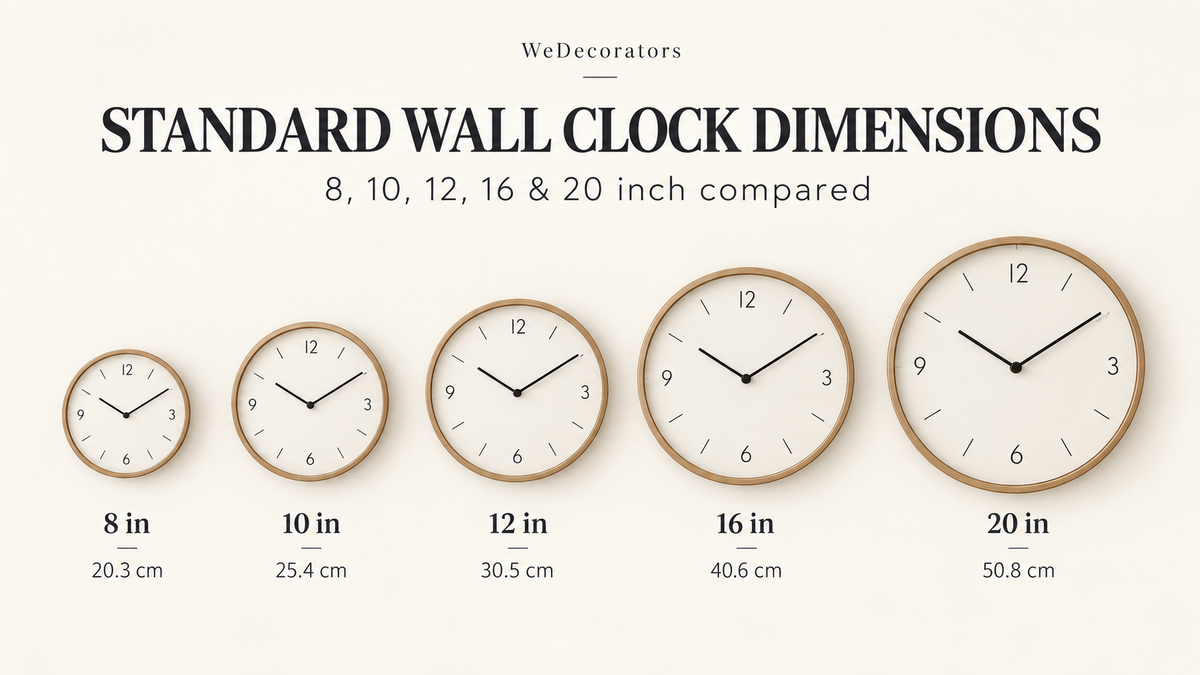
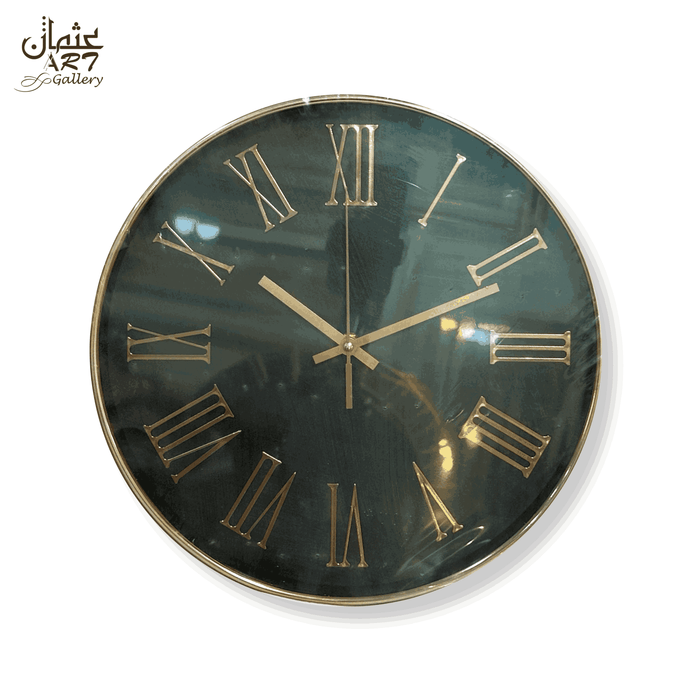
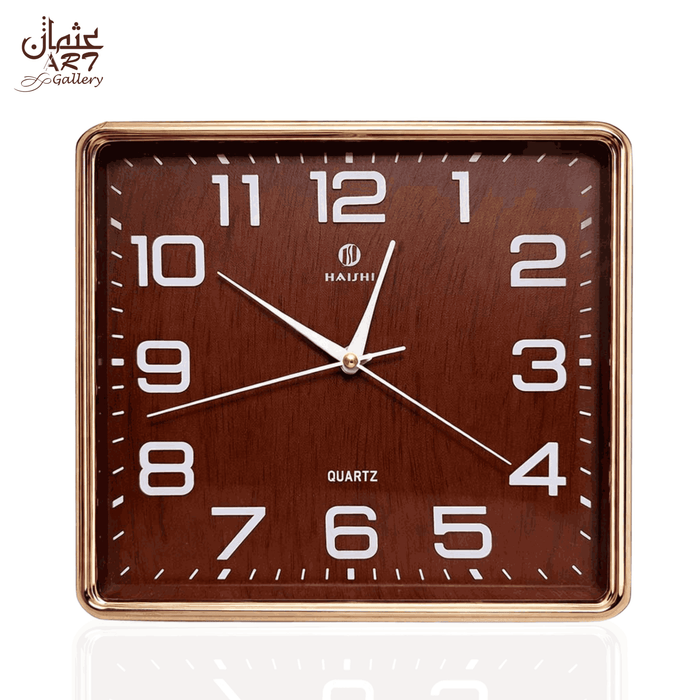
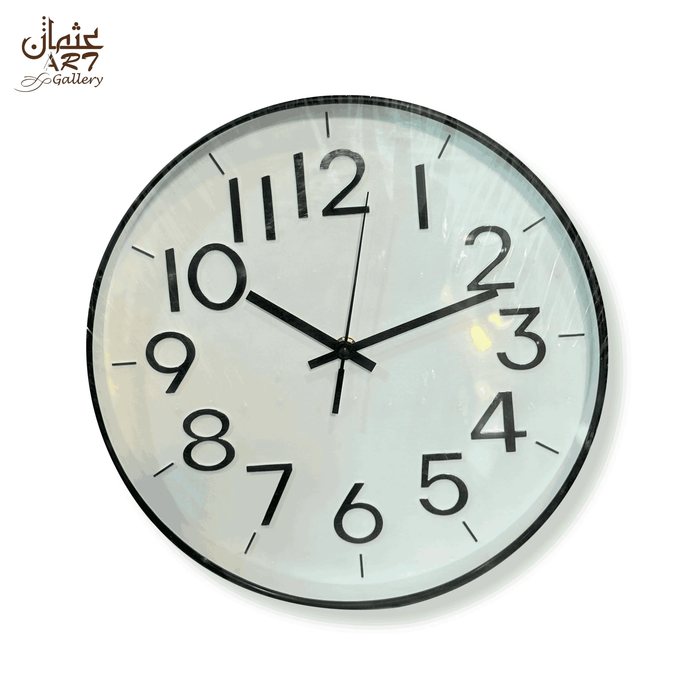
Understanding wall clock dimensions is easier when you compare actual measurements rather than relying on labels such as small, medium or large. Common household clocks are available in sizes such as 8, 10, 12, 16 and 20 inches, but those numbers can represent very different physical footprints depending on whether the clock is round, square or decorative.
This guide compares those dimensions directly in inches and centimetres, explains how much physical scale changes between each size and uses real WeDecorators products to show how ecommerce specifications work in practice. For the complete measuring procedure before ordering, see our guide to how to measure wall clock size correctly.
What Are Standard Wall Clock Dimensions?
There is no single universal standard wall clock size. Common household clocks often fall between about 8 and 20 inches, with 12 inches equal to 30.48 cm, 16 inches equal to 40.64 cm and 20 inches equal to 50.80 cm. Round clocks are normally described by diameter, while square and rectangular clocks should be described by width × height.
The phrase standard wall clock size is therefore best understood as shopper terminology for familiar dimensions rather than an official manufacturing standard. Different brands may sell 8, 10, 12, 13, 14, 16, 18, 20, 24-inch and larger designs.
Key Takeaways
- There is no universal residential wall-clock dimension used by every manufacturer.
- Round clocks are normally measured across the complete outer diameter.
- Square and rectangular clocks require width × height measurements.
- 12 inches equals exactly 30.48 cm.
- 16 inches equals exactly 40.64 cm.
- 20 inches equals exactly 50.80 cm.
- A larger diameter creates a disproportionately larger circular face area.
- Two clocks with identical physical dimensions can have different visual weight.
Wall Clock Dimensions in Inches and Centimetres
One inch equals exactly 2.54 centimetres. The table below gives both the exact mathematical conversion and a rounded reference that is easier to use when comparing a clock with a wall.
| Clock Size | Exact Metric Conversion | Rounded Metric Reference |
|---|---|---|
| 8 inches | 20.32 cm | 20.3 cm |
| 10 inches | 25.40 cm | 25.4 cm |
| 12 inches | 30.48 cm | 30.5 cm |
| 13 inches | 33.02 cm | 33.0 cm |
| 16 inches | 40.64 cm | 40.6 cm |
| 20 inches | 50.80 cm | 50.8 cm |
Wall Clock Dimension Ladder
The following labels are practical editorial categories rather than official industry standards.
| Size | Centimetres | Practical Category | Typical Visual Role |
|---|---|---|---|
| 8 in | 20.3 cm | Compact | Small accent |
| 10 in | 25.4 cm | Compact | Everyday practical scale |
| 12 in | 30.5 cm | Compact / medium | Familiar household scale |
| 16 in | 40.6 cm | Medium | Noticeable decorative presence |
| 20 in | 50.8 cm | Medium / statement | Stronger feature-wall presence |
8-Inch Wall Clock Dimensions
An 8-inch wall clock measures exactly 20.32 cm across when the 8-inch specification refers to the outer diameter of a round clock. That gives it a compact physical footprint and makes it easy to understand at relatively close viewing distances.
An 8-inch design may suit a narrow wall zone, small kitchen area, compact office position or a gallery arrangement where the clock forms only one part of the overall display. Readability still depends on the numeral size, contrast and hands rather than diameter alone.
WeDecorators does not currently have a verified supplied 8-inch product for this article, so 8 inches is used here strictly as a neutral dimensional reference.
10-Inch Wall Clock Dimensions
A 10-inch wall clock measures 25.40 cm across when the measurement represents a circular outer diameter.
It is 2 inches, or 5.08 cm, wider than an 8-inch clock and 2 inches narrower than a 12-inch clock. The numerical differences are equal, but that does not mean every design will appear equally spaced in visual scale.
A thick black frame, large numerals or a high-contrast dial can make one 10-inch clock look visually stronger than another clock with the same outer measurement.
No verified WeDecorators 10-inch example is being used here. The size remains a comparison reference rather than a current product claim.
12-Inch Wall Clock Size
A 12-inch measurement equals 30.48 cm. For a round clock that is explicitly listed as 12 inches in diameter, this means approximately 30.5 cm from one outer edge to the opposite outer edge through the centre.
For a square clock, however, the terminology changes. A 12 × 12-inch square measures 30.48 cm wide and 30.48 cm high. It should not be described as having a 12-inch diameter.
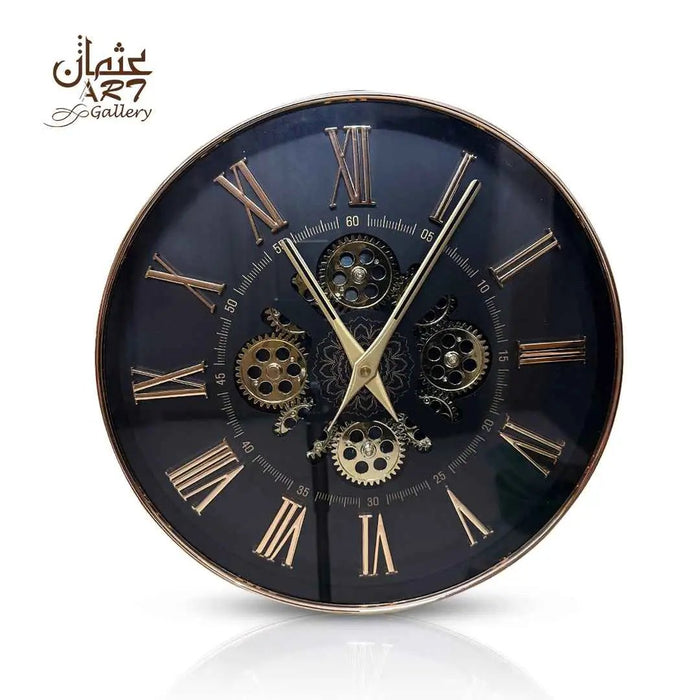
The 12 × 12-inch Haish Square Quartz Wall Clock is a useful real-world example. Its specification is 12 × 12 inches edge to edge, which means the dimensions describe the complete square width and height.
This distinction matters when comparing products online. A lifestyle photograph may make a square 12-inch clock and round 12-inch clock appear broadly similar, but their actual geometric footprints are not identical.
13-Inch Wall Clock: A Useful Real-World Intermediate Size
Actual ecommerce products do not always fit neat 8, 10, 12, 16 or 20-inch categories. A 13-inch wall clock demonstrates why product-specific dimensions matter.
Thirteen inches equals 33.02 cm, making it only 1 inch wider than a 12-inch reference but 3 inches narrower than a 16-inch reference.
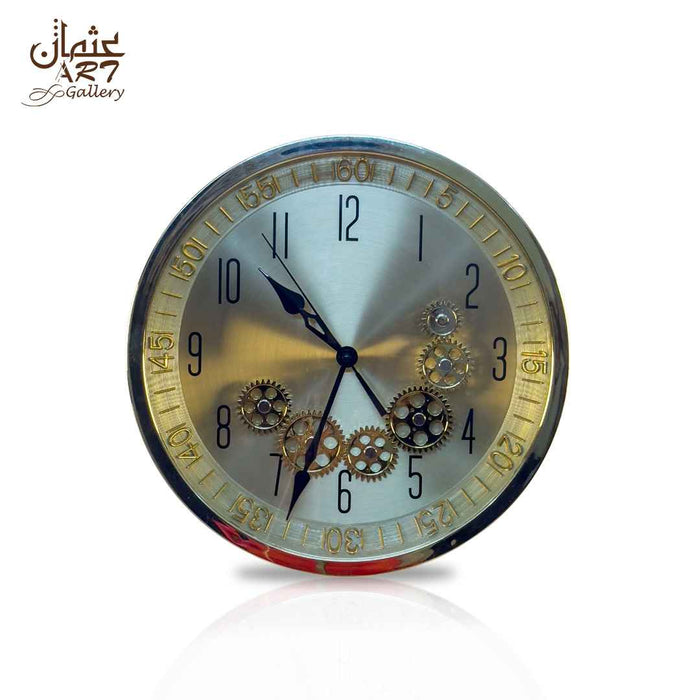
The 13-inch Resin Imported Clock is currently specified at 13 inches in diameter edge to edge. It therefore provides a useful bridge between familiar 12-inch household scale and the stronger presence of a 16-inch clock.
16-Inch Wall Clock Dimensions
A 16-inch wall clock measures 40.64 cm across when 16 inches refers to its outer diameter.
Compared with a 12-inch round clock, the diameter increases by 4 inches, or 10.16 cm. That is a 33.3% increase in diameter. However, describing the entire clock as simply "33% bigger" would be misleading because surface area grows much faster than diameter.
The 16-inch Silver Resin Wall Clock provides a verified WeDecorators example. Its product specification lists a 16-inch diameter edge to edge.
Its raised numerals, reflective silver rim and crystal-glitter face also demonstrate the difference between physical measurements and visual weight. A detailed 16-inch clock can attract more attention than a simpler design of similar dimensions.
20-Inch Wall Clock Dimensions
Twenty inches equals exactly 50.80 cm. If a clock is explicitly described as a 20-inch round clock, that would indicate a diameter of approximately 50.8 cm.
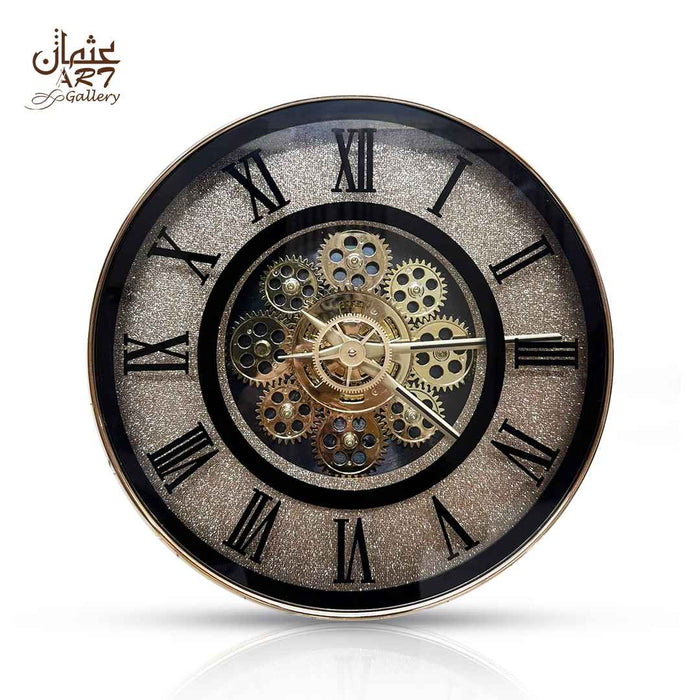
Not every 20-inch product is circular, however. The 20 × 20-inch Sparkle Gear is currently listed using width × height dimensions. It should therefore be described as measuring 20 × 20 inches rather than automatically being rewritten as a 20-inch diameter.
A 20-inch scale creates considerably more physical wall occupation than 12 or 16 inches. If you are considering dimensions above this range, continue with our guide to choosing a clock for a larger wall.
Why Diameter Does Not Grow Like Face Area
A major reason wall-clock size is difficult to judge from numbers alone is that circular area depends on the square of the radius.
For a simple round clock:
Area = π × radius²
A 20-inch round clock therefore does not merely feel like a 12-inch clock with 8 extra inches added. Its circular face occupies far more surface area.
| Round Diameter | Approx. Face Area | Relative to 12-Inch |
|---|---|---|
| 8 in | 50.3 sq in | 0.44× |
| 10 in | 78.5 sq in | 0.69× |
| 12 in | 113.1 sq in | 1.00× |
| 16 in | 201.1 sq in | 1.78× |
| 20 in | 314.2 sq in | 2.78× |
A 16-inch circle has about 1.78 times the face area of a 12-inch circle. A 20-inch circle has approximately 2.78 times the face area of a 12-inch circle.
This calculation applies to simple circular footprints only. It should not be treated as a universal formula for perceived visual dominance because open frames, transparent areas, decorative extensions and different colours can change how large a clock appears.
12-Inch Round Clock vs 12 × 12-Inch Square Clock
A round clock with a 12-inch outer diameter and a square clock measuring 12 × 12 inches have the same maximum width, but they do not cover the same geometric area.
12-Inch Round Clock
Radius = 6 inches.
Area = π × 6² = approximately 113.1 square inches.
12 × 12-Inch Square Clock
Area = 12 × 12 = 144 square inches.
The square footprint therefore encloses approximately 27.3% more geometric area than the 12-inch circle.
That does not automatically make the square clock look 27.3% more dominant. A pale open-frame square may look lighter than a dark, highly decorative round clock. The calculation describes geometric footprint, not perceived visual weight.
8 vs 10 vs 12 vs 16 vs 20-Inch Wall Clock Comparison
| Size | Centimetres | Increase From Previous Size | Typical Scale Impression | WeDecorators Example |
|---|---|---|---|---|
| 8 in | 20.3 cm | Reference starting point | Compact | No supplied verified example |
| 10 in | 25.4 cm | +2 in / +5.08 cm | Compact | No supplied verified example |
| 12 in | 30.5 cm | +2 in / +5.08 cm | Familiar compact-medium scale | Haish Square, 12 × 12 in |
| 16 in | 40.6 cm | +4 in / +10.16 cm | Medium decorative presence | Silver Resin, 16 in diameter |
| 20 in | 50.8 cm | +4 in / +10.16 cm | Stronger statement scale | Sparkle Gear, 20 × 20 in |
Understanding the Size Jumps
The numerical progression is:
- 8 to 10 inches = +2 inches, or +5.08 cm
- 10 to 12 inches = +2 inches, or +5.08 cm
- 12 to 16 inches = +4 inches, or +10.16 cm
- 16 to 20 inches = +4 inches, or +10.16 cm
The larger jumps are particularly noticeable because circular area grows faster than diameter. Moving from a 12-inch round clock to a 16-inch round clock increases diameter by one-third but increases circular area by approximately 77.8%.
Moving from 16 inches to 20 inches increases diameter by 25%, while circular area increases by approximately 56.3%.
12 vs 16-Inch Wall Clock
A 12-inch round clock is approximately 30.48 cm across, while a 16-inch round clock is approximately 40.64 cm across. The physical diameter difference is exactly 4 inches, or 10.16 cm.
For simple circular footprints, the 12-inch face covers approximately 113.1 square inches, while the 16-inch face covers approximately 201.1 square inches. That makes the 16-inch circular area approximately 1.78 times the 12-inch area.
In practical terms, 16 inches has substantially more wall presence even though the diameter is only 4 inches greater. Readability still depends on hand thickness, numeral size, contrast, lighting and viewing distance.
16 vs 20-Inch Wall Clock
A 16-inch measurement equals 40.64 cm, while 20 inches equals 50.80 cm. The difference is again 4 inches, or 10.16 cm.
If both clocks are simple circles, the 16-inch face covers about 201.1 square inches and the 20-inch face about 314.2 square inches. The 20-inch circular footprint therefore has about 56.3% more face area.
Design density still matters. A 16-inch clock with a thick dark frame, raised numerals and detailed centre can sometimes appear visually stronger than a minimalist 20-inch clock with large areas of open space.
12 vs 16 vs 20-Inch Wall Clock at a Glance
| Dimension | 12 Inch | 16 Inch | 20 Inch |
|---|---|---|---|
| Exact centimetres | 30.48 cm | 40.64 cm | 50.80 cm |
| Approx. round face area | 113.1 sq in | 201.1 sq in | 314.2 sq in |
| Relative round area | 1.00× | 1.78× | 2.78× |
| Broad scale impression | Compact-medium | Noticeable | Statement-oriented |
Round Clock Dimensions vs Square Clock Dimensions
Round Wall Clock
A round clock is normally described using its diameter. Measure straight across the widest outside edge through the centre.
Square Wall Clock
A square clock should be described using width × height. A 12 × 12-inch clock means 12 inches wide and 12 inches high.
Rectangular Wall Clock
Record the full external width × height. Do not describe the longest side as a diameter.
Decorative or Irregular Clock
Use the maximum outside width × maximum height, including decorative elements that extend beyond the central dial.
For the complete procedure and wall-measuring steps, use the complete wall clock measuring guide.
Frame Size, Dial Size and Edge-to-Edge Dimensions
The dial is the central face where the hands and time markings appear. The outer dimension describes the complete physical product.
If a clock has a 14-inch dial but its frame makes the complete product 16 inches across, use the 16-inch outer measurement when planning wall space.
Likewise, a product described as 13 inches diameter edge to edge normally refers to the complete outside width of the round clock. A specification of 12 × 12 inches edge to edge identifies the complete external width and height of a square product.
Do not estimate hidden dial dimensions when they are not supplied.
Visual Size vs Physical Dimensions
Physical dimensions are measurable. Visual weight is perceptual.
Two clocks measuring exactly 16 inches can create very different impressions because decorative features change how strongly the design attracts attention.
| Feature | Typical Visual Effect |
|---|---|
| Thick dark frame | Stronger visual presence |
| Large raised numerals | Stronger visual presence |
| Dense gear-inspired centre | Stronger visual presence |
| Transparent or open centre | Lighter appearance |
| Thin pale frame | Lighter appearance |
| Glitter or reflective finish | More interaction with surrounding light |
These are design tendencies rather than fixed rules. Wall colour, surrounding furniture, shadows and lighting can change the final effect.
Real WeDecorators Wall Clock Size Ladder
| WeDecorators Product | Current Dimensions | Shape | Dimension Type | Reference Role |
|---|---|---|---|---|
| Haish Square Quartz Wall Clock | 12 × 12 in | Square | Width × height | 12-inch reference |
| Resin Imported Clock | 13 in | Round | Diameter | Intermediate reference |
| Silver Resin Wall Clock | 16 in | Round | Diameter | 16-inch reference |
| Sparkle Gear | 20 × 20 in | Use listed overall specification | Width × height | 20-inch reference |
This product ladder demonstrates why dimensions should always be read together with shape and measurement type. A shopper should not assume that every product carrying a single familiar number is a round diameter.
You can compare current wall clock sizes and designs after establishing which physical scale works for your wall.
If you also want style and buying considerations rather than dimensions alone, see our guide to the best wall clocks in Pakistan.
Which Wall Clock Dimension Should You Choose?
This article is intentionally a dimension reference rather than a full room-by-room sizing guide, but the following broad scale descriptions can help narrow your comparison.
8 to 10 Inches
Compact physical scale for narrow wall zones, close viewing or arrangements where the clock is one element among other décor.
Around 12 Inches
A familiar household scale that remains relatively compact while giving more dial area than 8 or 10 inches.
Around 16 Inches
A noticeably stronger decorative footprint, particularly when the clock has a substantial frame or detailed face.
Around 20 Inches
A stronger feature-oriented footprint that occupies approximately 50.8 cm of width when the listed dimension refers to a full 20-inch span.
For detailed advice according to specific rooms, furniture and wall widths, use our room-by-room wall clock size guide. For living-room-specific styling, see our guide to wall clocks for living rooms.
Viewing Distance Still Matters
A larger clock does not automatically guarantee easier reading. Readability also depends on numeral size, hand thickness, contrast between the hands and dial, room lighting and the distance from which the clock will normally be viewed.
There is no single universal viewing-distance formula that applies to every wall clock design.
Use a Wall Mock-Up Before Ordering
- Find the exact outer product dimensions.
- Mark the width and height on the wall using removable tape or paper.
- Stand at your normal viewing position.
- Photograph the outline to judge the surrounding negative space.
- Repeat with another candidate size if necessary.
This test makes the difference between 12, 16 and 20 inches much easier to understand than relying on product photography alone.
Common Wall Clock Dimension Mistakes
- Treating 12 × 12 inches as a 12-inch diameter. Diameter applies to circular measurements. Use width × height for square clocks.
- Measuring only the dial. Use the complete external frame or decorative footprint when planning wall clearance.
- Ignoring decorative extensions. Measure to the furthest outside point of irregular designs.
- Assuming "standard" means one universal dimension. Residential wall clocks are sold in many different sizes.
- Confusing inches and centimetres. Multiply inches by exactly 2.54 to convert to centimetres.
- Assuming 20 inches is only slightly larger than 16. For circles, the area increases much faster than the diameter.
- Treating square and round footprints as identical. A 12 × 12-inch square encloses more area than a 12-inch-diameter circle.
- Choosing from lifestyle photos alone. Camera distance, lens perspective and furniture scale can distort perceived size.
- Ignoring viewing distance. A physically appropriate clock may still be difficult to read if its markings are small or low contrast.
- Confusing physical scale with visual weight. Colour, texture, frame thickness and decorative detail can make equal-sized clocks appear different.
Online Wall Clock Dimension Checklist
- Check whether the specification means diameter or width × height.
- Confirm whether the stated figure represents edge-to-edge dimensions.
- Convert inches to centimetres if that makes the scale easier to understand.
- Check the product shape.
- Account for outer frames and decorative extensions.
- Compare the overall dimensions with your usable wall area.
- Consider the normal viewing distance.
- Assess the clock's visual weight as well as its physical size.
- Review close-up product images for frame and dial details.
- Mark the full outline on the wall before ordering.
- Verify the current product specification before checkout.
Frequently Asked Questions About Wall Clock Dimensions
What is the standard wall clock size?
There is no single universal standard wall clock size. Shoppers commonly encounter clocks around 8, 10, 12, 16 and 20 inches, as well as many intermediate and larger dimensions. Always use the exact specification for the individual product rather than assuming one size is standard.
What are common wall clock dimensions?
Common household wall clock dimensions include approximately 8, 10, 12, 14, 16, 18 and 20 inches, with larger statement designs extending beyond that range. Manufacturers are not required to follow one universal residential clock dimension.
Is a wall clock measured by diameter?
A round wall clock is normally described using its diameter, measured straight across the widest outside point through the centre. Square, rectangular and irregular clocks should instead use complete width and height measurements.
How big is a 12-inch wall clock?
A 12-inch round wall clock measures 30.48 cm across its diameter if the specification refers to the complete outer size. A 12 × 12-inch square clock measures 30.48 cm wide and 30.48 cm high.
What is a 12-inch wall clock in centimetres?
Twelve inches equals exactly 30.48 centimetres. For everyday comparison, this is often rounded to approximately 30.5 cm.
Is a 16-inch wall clock large?
A 16-inch wall clock measures 40.64 cm across if the dimension represents diameter. It has a noticeably greater physical footprint than a 12-inch clock, although whether it appears large depends on wall scale and visual design.
How much bigger is a 16-inch clock than a 12-inch clock?
The diameter is 4 inches, or 10.16 cm, greater. For simple round footprints, a 16-inch circle has approximately 77.8% more face area than a 12-inch circle.
Is a 20-inch wall clock considered large?
A 20-inch span equals 50.8 cm and can create substantial decorative presence, but there is no universal definition of "large". Its perceived scale depends on the wall, surrounding furniture and the clock's visual weight.
What is 20 inches in centimetres?
Twenty inches equals exactly 50.80 centimetres.
How do you measure a square wall clock?
Measure the complete external width from left to right and the complete external height from top to bottom. Record the result as width × height, such as 12 × 12 inches.
Is a 12 × 12-inch square clock the same size as a 12-inch round clock?
They have the same maximum width, but not the same geometric area. A 12 × 12-inch square covers 144 square inches, while a 12-inch-diameter circle covers approximately 113.1 square inches.
Should I choose a 12, 16 or 20-inch wall clock?
Choose according to the actual wall zone, viewing distance and visual weight of the design. A 12-inch clock offers compact scale, 16 inches provides more noticeable presence and 20 inches creates a substantially stronger footprint. Test each outline on the wall before deciding.
Final Thoughts on Wall Clock Dimensions
Accurate wall clock dimensions make online comparison much easier because they replace vague labels with measurable scale. Start by identifying the usable wall zone, then confirm whether the product uses diameter or width × height. Convert the measurement into centimetres if that makes the footprint easier to visualise.
Next, compare the physical difference between 8, 10, 12, 16 and 20 inches. Remember that circular face area grows much faster than diameter, and that square and round footprints are not geometrically identical. Consider viewing distance, frame thickness, decorative density and visual weight before making the final decision.
Finally, mark the exact outer dimensions on your wall and verify the current specification before ordering. If you need the complete measuring process, revisit our wall clock measurement guide. When you are ready to compare real designs, browse the WeDecorators wall clock collection.
